Stemli
Helping independent florists reduce waste, make smarter purchasing decisions and grow repeat business with AI.
My Contribution
- Founder & Product Strategy
- Product Research
- UX/UI Design
- AI Workflow Design
- 2026–Present
The Problem
Florists are incredibly creative people, but running a flower shop involves much more than arranging flowers.
Through exploring the industry and speaking with florists, I noticed that many traditional shop owners aren't particularly comfortable with technology. Their businesses often rely on familiar, manual ways of working.
One of the biggest operational challenges is waste.
Flowers have a limited shelf life. Every unsold stem represents money spent on stock that may never generate a return.
I also noticed an opportunity around customer relationships. Without organised customer records, florists have limited ways to reconnect with previous buyers or encourage repeat purchases.
The Opportunity
I wanted to explore how software could help florists become more profitable and sustainable without asking them to become technology experts.
The challenge was to create something powerful behind the scenes but incredibly simple to use.
Rather than requiring florists to learn complicated dashboards, Stemli would connect information from their existing business systems and translate it into clear, practical recommendations.
The goal was simple: less waste, stronger customer relationships and better profitability.
Validation
How the idea evolved.
Understanding Florists
Speaking with florists helped me appreciate how creative and hands-on the profession is. It also highlighted the importance of designing for people who may have little interest in learning complicated software.
Identifying the Biggest Problem
Flower waste stood out as a major opportunity. Unsold flowers lose their value quickly, creating both financial losses and unnecessary environmental waste.
Exploring Existing Technology
I investigated existing florist software and POS systems, including iZettle (Zettle). I saw an opportunity for a more accessible, florist-focused solution built around everyday decisions rather than complex administration.
Connecting the Data
I explored how sales information from a POS system could be compared with flower purchase invoices to help identify stock that wasn't selling quickly enough. This led to the idea of recommending promotional bouquets using flowers approaching the end of their sellable life.
The Adoption Challenge
One of the biggest difficulties I encountered was pitching the concept to traditional florists. Some were reluctant to introduce new software into their businesses, even when the potential benefits were explained. This challenged my assumption that identifying a valuable problem would automatically create demand for a solution.
The Solution
Stemli is an AI-powered business assistant concept designed to make running a flower shop more profitable, sustainable and manageable.
Its central idea is to connect information that florists already generate through sales and purchasing, then use AI to recommend useful actions.
Instead of requiring owners to analyse data themselves, Stemli would help answer questions such as: Which flowers aren't selling? What stock is at risk of going to waste? Could those flowers be turned into promotional bouquets? Which previous customers could be encouraged to return?
The experience would be designed around simple recommendations rather than complicated reports.
Inside the Product
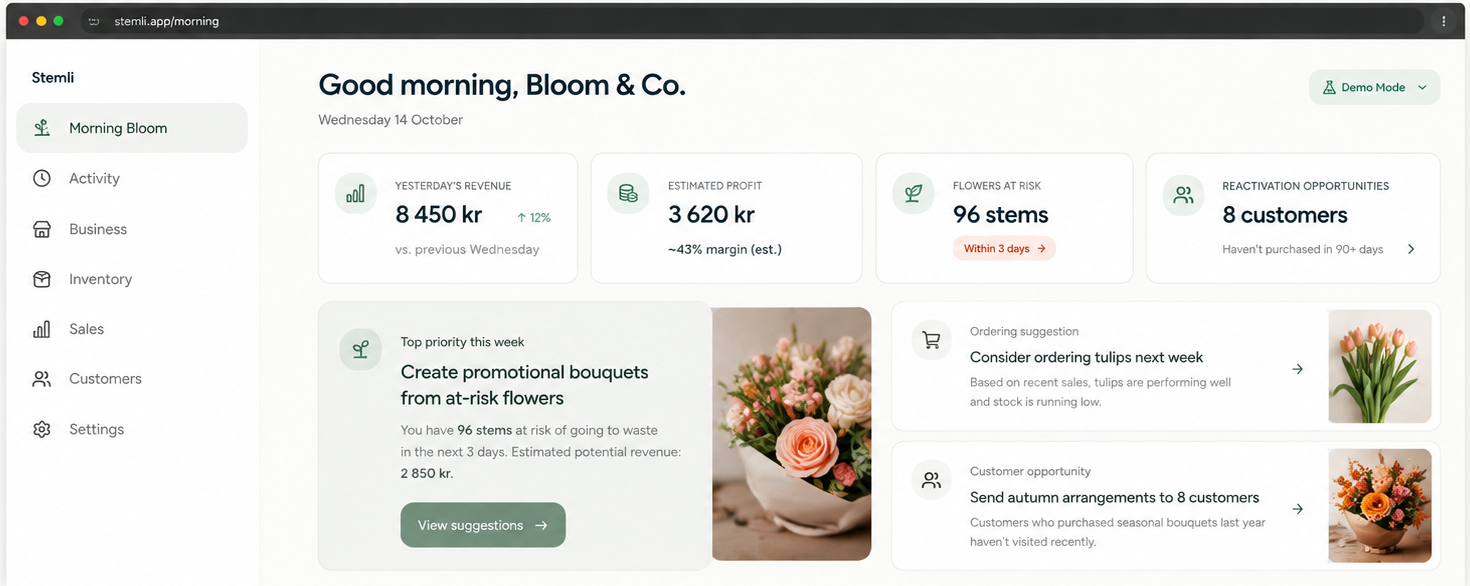
Morning Bloom
A simple daily overview showing what needs attention, including stock at risk of waste, sales patterns and opportunities to increase revenue.
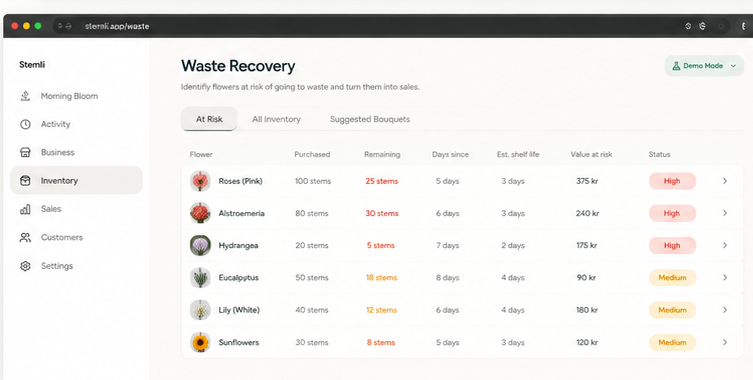
Waste Recovery
Compare flower purchases from supplier invoices with POS sales data to estimate which flowers may remain unsold. Suggest promotional bouquets using flowers with a limited remaining shelf life, helping recover value before they become waste.
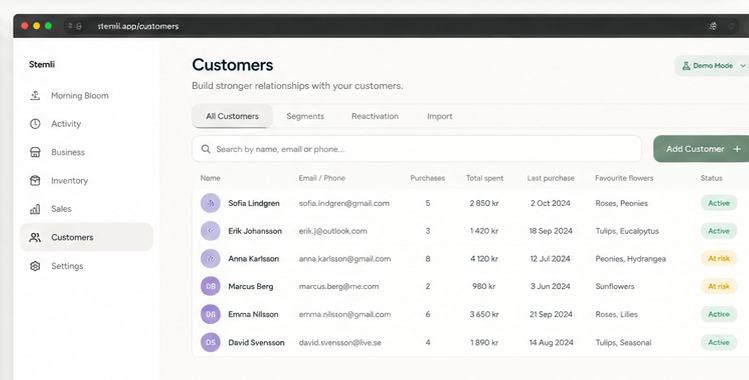
Customer Relationships
A simple CRM concept for storing customer information, tracking preferences where appropriate and identifying opportunities to reconnect with previous buyers.
1 / 3
Concept interface shown with illustrative demonstration data.
Decisions
Why I Built It This Way
Simplicity Over Complexity
Why
Many of the florists I encountered were highly creative but not particularly interested in technology. I wanted to design an experience that required very little learning. The software should do the complicated work behind the scenes and present only the information that matters.
Trade-off
A simple interface requires more work behind the scenes to turn complex data into understandable recommendations.
Waste Reduction First
Why
Unsold flowers represent both lost profit and unnecessary environmental waste. By comparing POS sales with purchasing invoices, I wanted to explore whether Stemli could identify flowers at risk and recommend promotional bouquets before their value disappeared.
Trade-off
Accurately estimating remaining stock requires reliable sales and purchasing data. Bouquets containing multiple flower varieties also make stock tracking more complex.
Build on Existing Systems
Why
I didn't want florists to replace the tools they already use or manually enter the same information twice. Exploring connections with systems such as Zettle and supplier invoices could help reduce the amount of work required from shop owners.
Trade-off
POS integration, invoice interpretation and accurate stock reconciliation introduce technical challenges.
Customer Retention as a Growth Opportunity
Why
I noticed that customer information wasn't always being collected or organised in a way that supported repeat business. A simple CRM could help florists build stronger customer relationships and promote relevant products or occasions.
Trade-off
Customer data collection requires consent, privacy safeguards and an experience that doesn't add unnecessary administrative work.
Adoption Before Features
Why
Pitching the idea to traditional florists showed me that even potentially useful software can be difficult to introduce when people are comfortable with their existing routines. This changed how I thought about the product. Making it easy to adopt became just as important as the features themselves.
Trade-off
Some technically ambitious features may need to wait until a simpler initial workflow has demonstrated value.
Lessons Learned
- The user isn't always looking for software
- Florists may care deeply about reducing waste and increasing profit without wanting another system to manage. The product needs to fit their working habits.
- Good UX can make complex technology feel simple
- The ambition was to use AI, POS data and purchasing information behind the scenes while keeping the experience approachable.
- A real problem doesn't guarantee adoption
- My initial outreach taught me that willingness to change is a separate challenge from identifying a business problem.
Current Status
- Product Concept and Workflow Design
- The core product direction focuses on waste reduction, simple business recommendations and customer retention.
- Early Industry Research
- I explored existing POS systems, purchasing workflows and the challenges of introducing new technology to independent florists.
- Biggest Challenge
- Convincing traditional shop owners to try a new way of working.
- Next Step
- Validate whether a simple waste-recovery workflow provides enough measurable value to encourage adoption before investing in more advanced functionality.
Roadmap
Future Vision
- 01
POS & Invoice Integration
Connect sales data with flower purchasing information to provide a clearer picture of stock movement.
- 02
AI Waste Recovery
Recommend promotional bouquets using flowers at risk of becoming unsellable.
- 03
Customer CRM
Help florists build and maintain customer relationships with simple, privacy-conscious tools.
- 04
Smarter Ordering
Use sales and purchasing patterns to help reduce overordering and improve profitability.
Final Reflection
Stemli taught me that identifying a problem is only part of building a useful product.
I saw an opportunity to reduce waste, improve profitability and help florists build stronger customer relationships.
But speaking with florists also revealed something equally important: many weren't looking for more technology in their lives.
That changed the challenge from simply building an AI-powered business tool to designing something so intuitive and useful that adopting it would feel easier than continuing without it.
Next story
Great Mondays