Bilbra
Helping independent car dealerships manage inventory, track costs and understand profitability.
My Contribution
- Founder & Product Builder
- Product Strategy
- UX/UI Design
- Full-Stack Development
- 2026–Present
The Problem
Small independent car dealerships have a lot to manage beyond selling cars.
Every vehicle comes with purchase costs, repairs, preparation expenses, customer enquiries and paperwork. When I looked into existing dealership management software, many of the established solutions seemed to be built for larger dealerships managing 100+ vehicles — with pricing and complexity that made them less attractive to smaller independent businesses.
From my research, smaller dealerships often relied on Excel spreadsheets or had no dedicated inventory software at all. That makes one important question surprisingly hard to answer: how much money are we actually making on each car?
The Opportunity
I saw an opportunity to create an affordable, accessible alternative built specifically for independent dealerships managing fewer than 50 vehicles.
My goal wasn't to reinvent enterprise dealership software. It was to make the most useful features accessible to smaller businesses, without unnecessary complexity.
The aim was to make vehicle management easier while giving owners a clearer understanding of their costs and profitability.
Validation
How the idea evolved.
Industry Insight
I explored the idea with a former car salesperson who understood the challenges dealerships face.
Competitive Research
I explored existing dealership management platforms and noticed that many focused on larger businesses, leaving an opportunity for simpler and more affordable software.
Understanding Existing Workflows
My research suggested that smaller dealerships frequently managed inventory through spreadsheets or manual processes rather than dedicated systems.
Reducing Adoption Barriers
Because Excel was already familiar to many potential users, I prioritised making it easy to import existing spreadsheet data into Bilbra rather than forcing dealerships to enter everything manually.
Early Market Interest
During our initial discussions, we contacted a small dealership managing approximately 10–40 vehicles. They expressed interest in testing a solution like Bilbra.
MVP Definition
I narrowed the initial product to inventory management, vehicle expenses, customer follow-ups and sales tracking.
Product Development
I built a working web application to demonstrate how these workflows could operate together.
Next Step
Test the product with dealership users, observe their actual workflows and refine the experience based on feedback.
The Solution
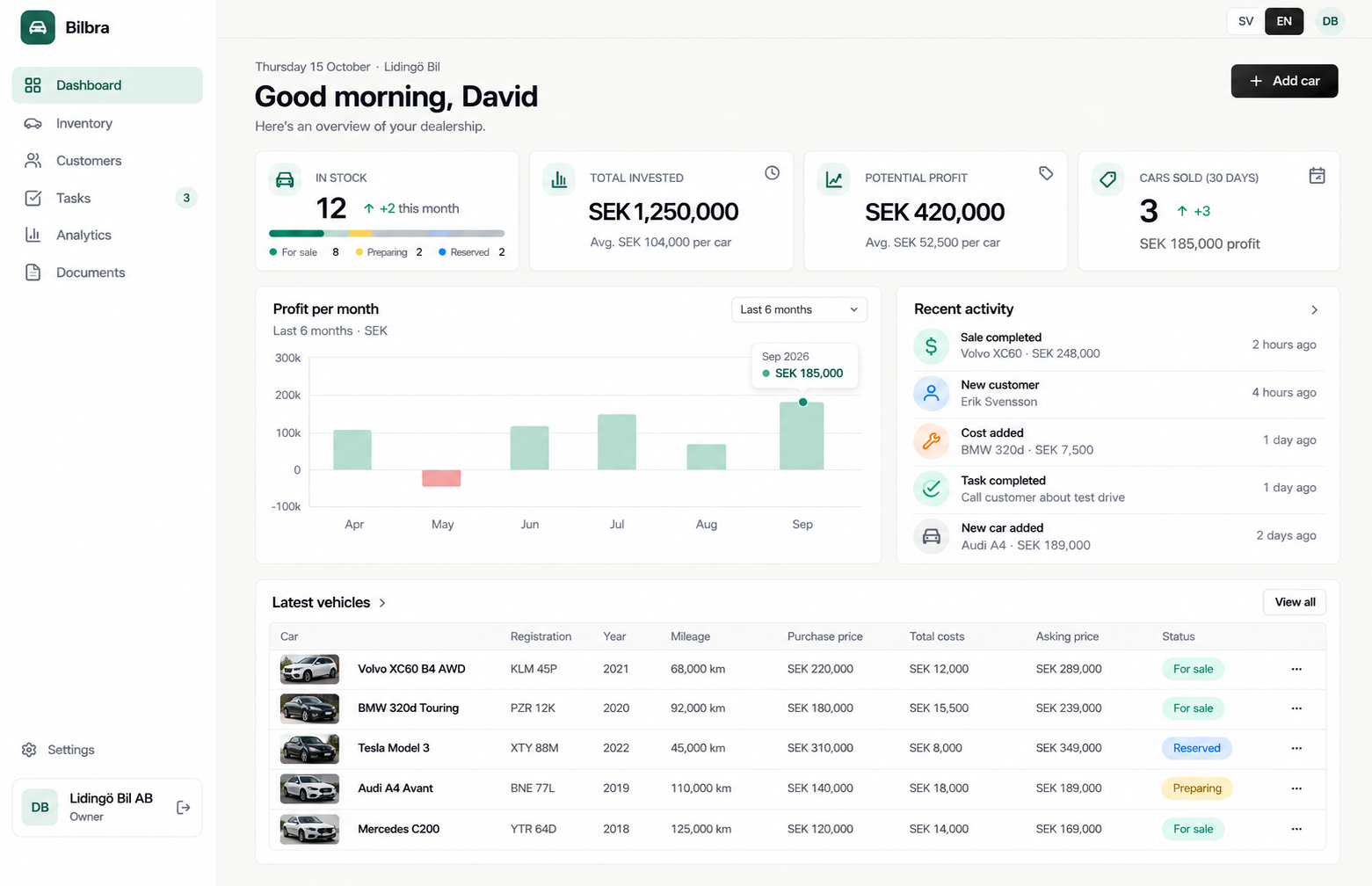
Bilbra is a web-based dealership management platform designed to bring the essential parts of running a small dealership into one place. It was designed around three priorities.
Simplicity — an intuitive interface with a minimal learning curve, so dealership owners can become comfortable with the software quickly.
Financial visibility — a central dashboard showing inventory, capital invested, vehicle costs, potential profits and overall dealership performance.
Easy onboarding — support for importing existing Excel inventory data, reducing the work required to move away from spreadsheets.
Dealers can manage their inventory, record vehicle expenses, track customers and follow-ups, organise tasks and documents, and record completed sales.
The objective is to help smaller dealerships understand their business financially, without requiring complicated enterprise software.
Inside the Product
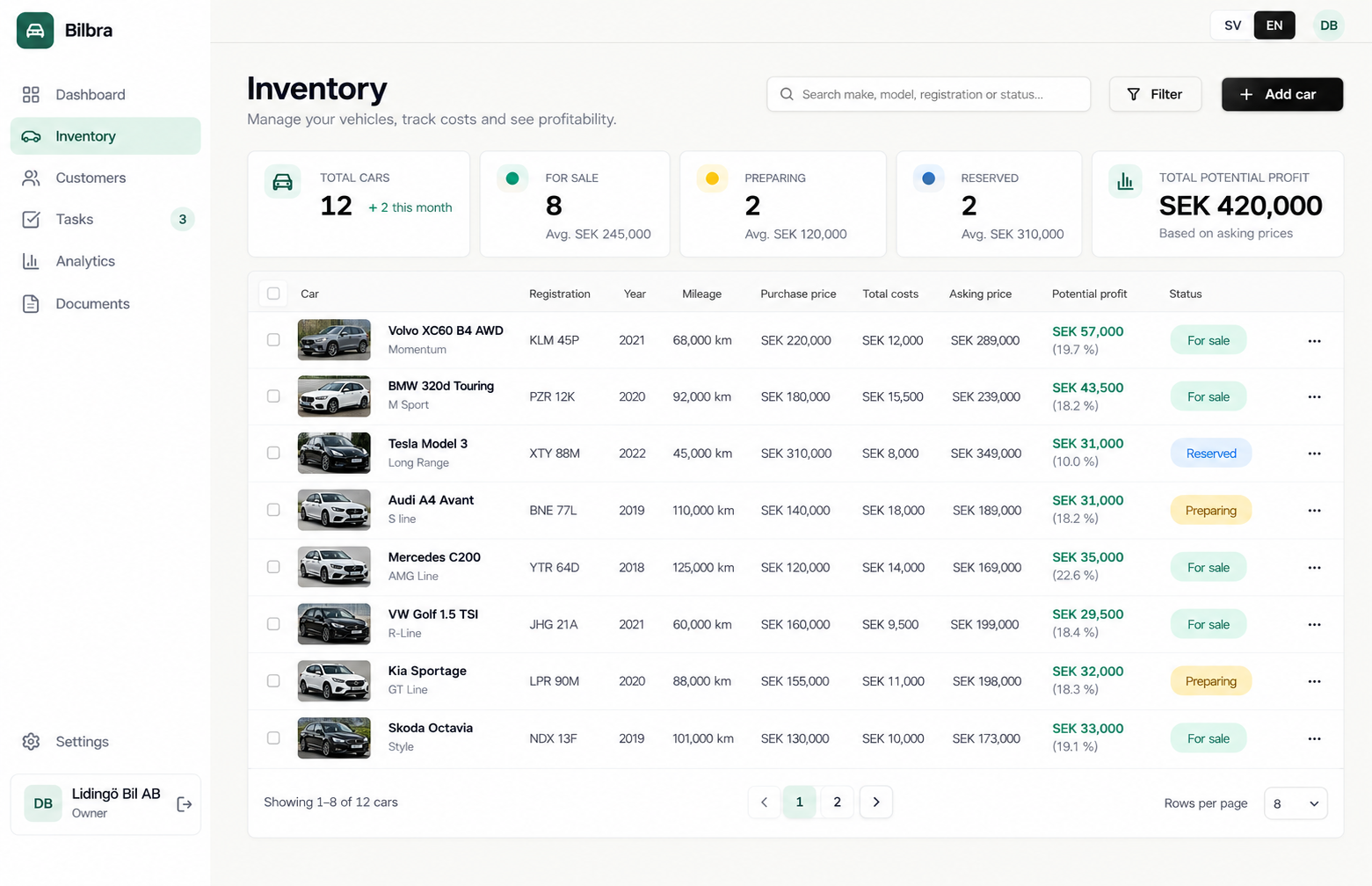
Vehicle Inventory
Manage every vehicle in one organised dashboard, with key details and its current status easily accessible.
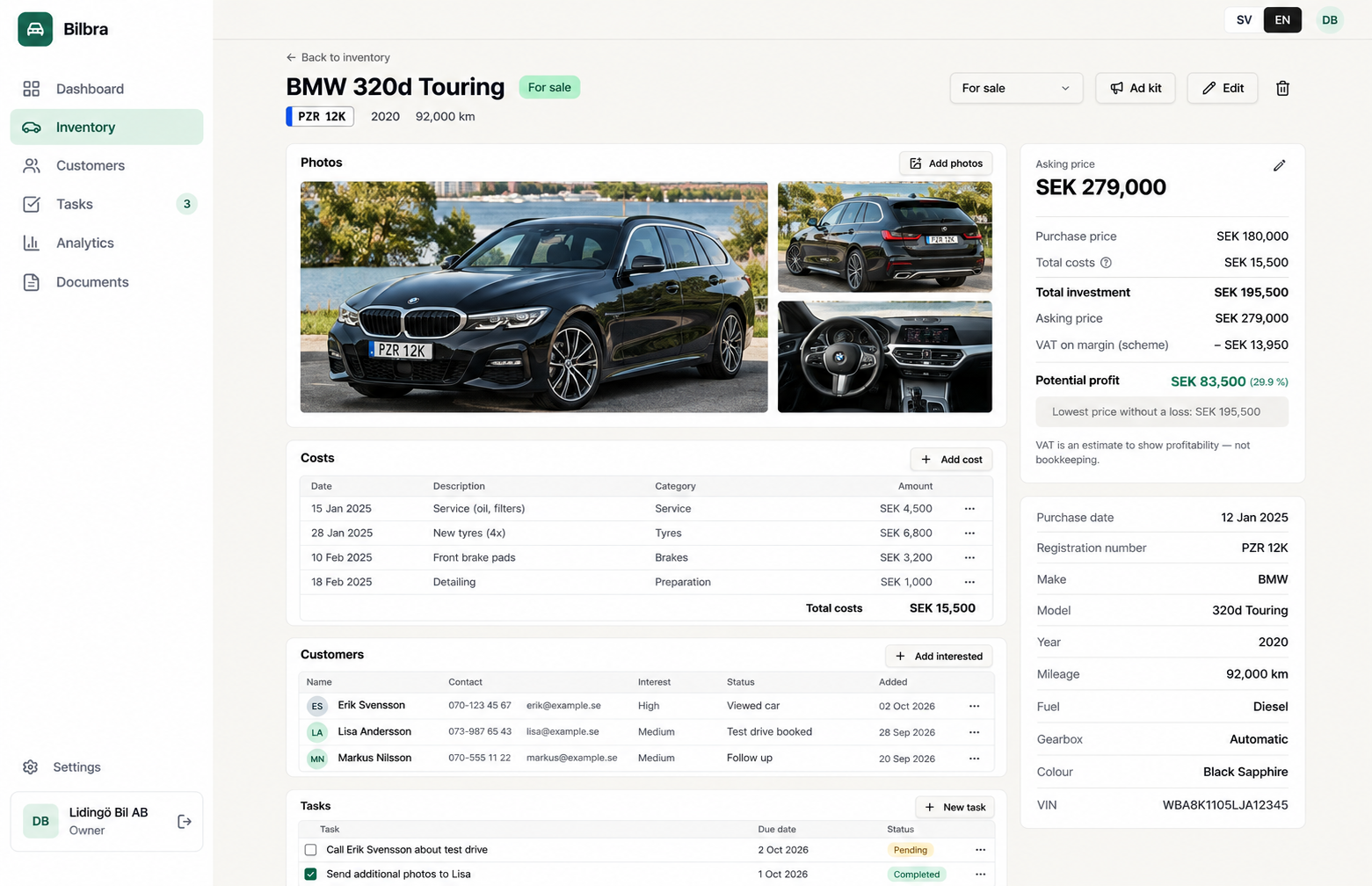
Vehicle Costs
Track purchase prices, repairs and additional expenses to understand how much has been invested in each vehicle.
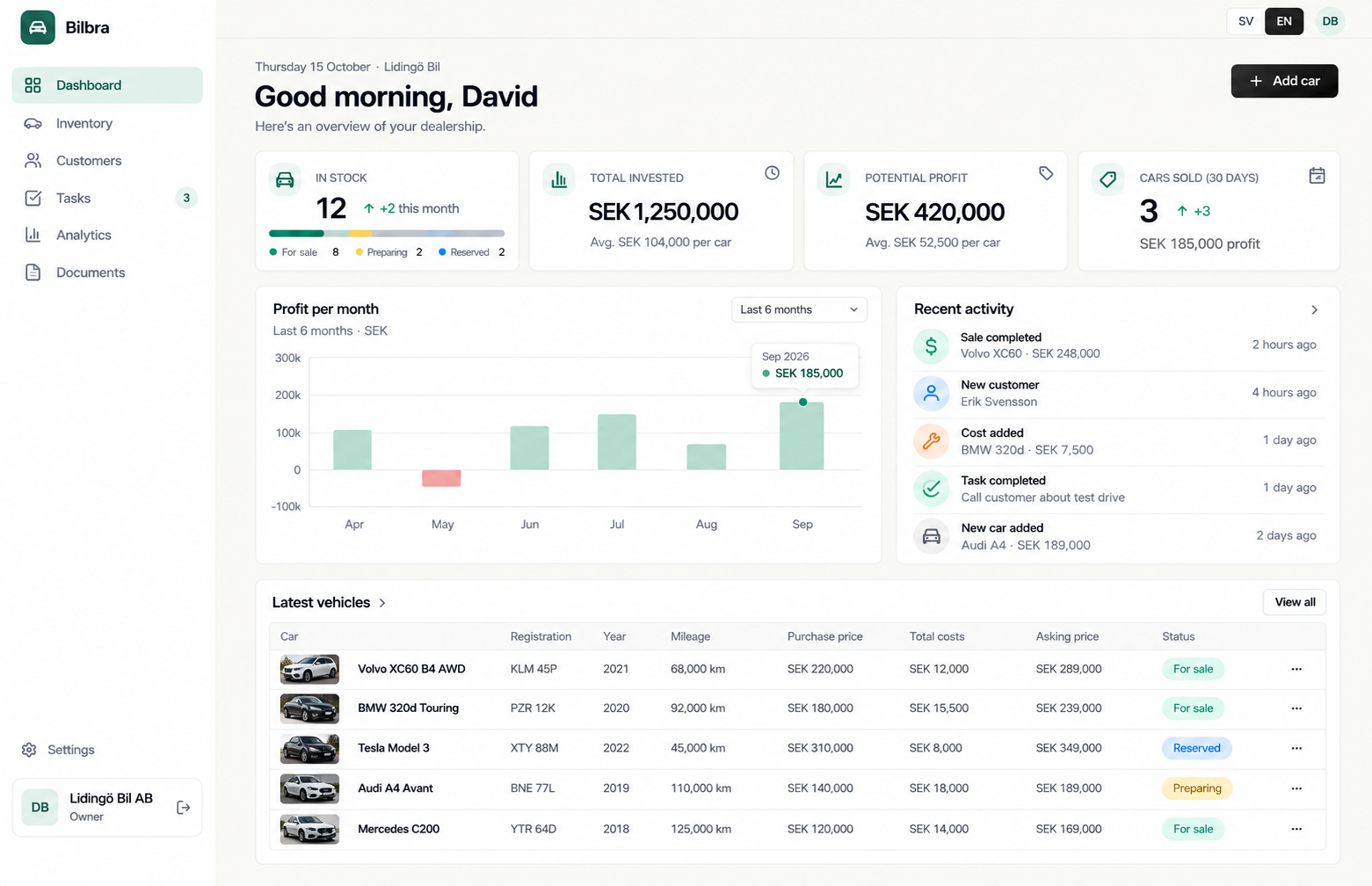
Profitability Tracking
Record the final sale price and calculate the profit on each vehicle based on its recorded costs.
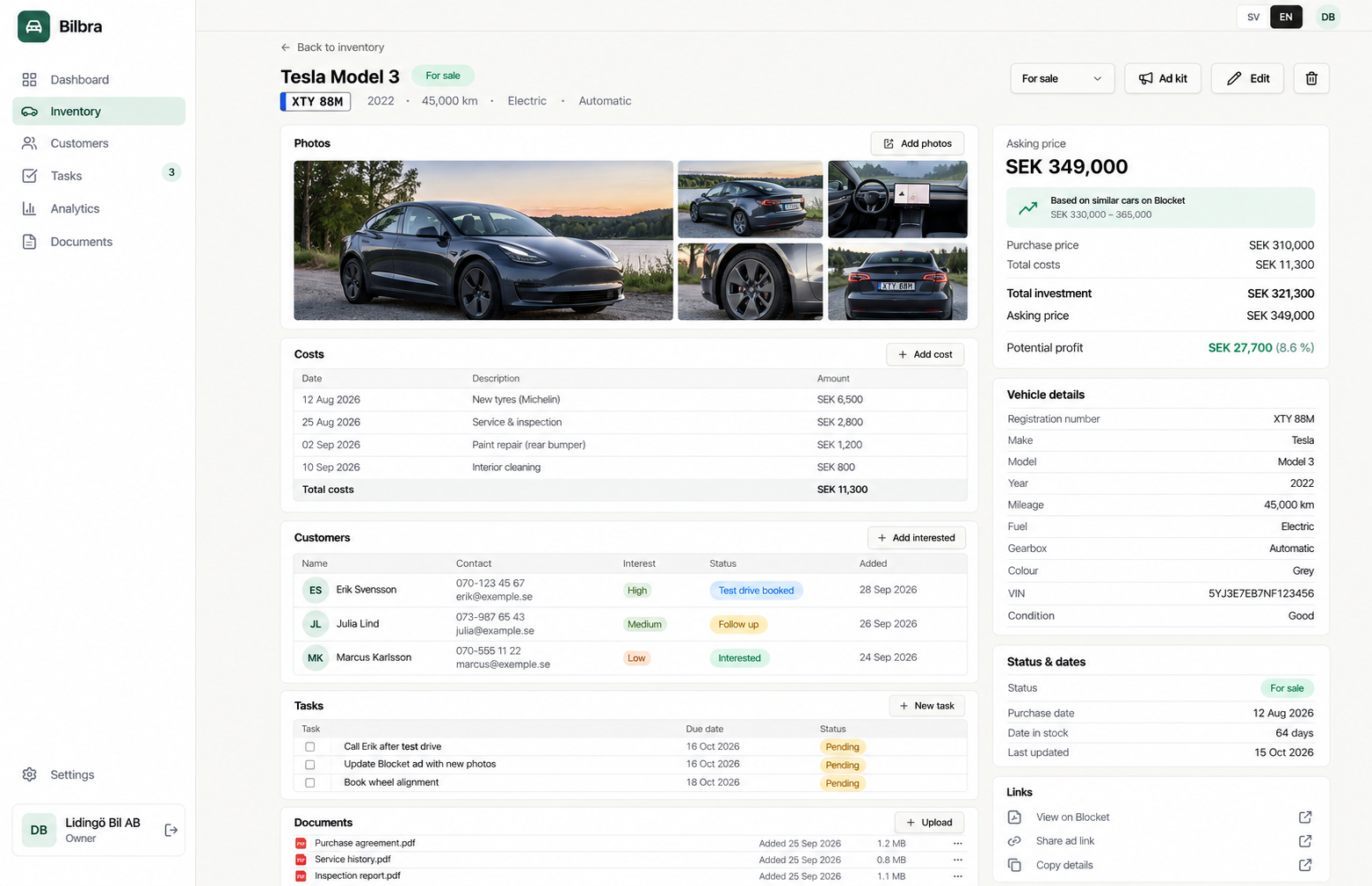
Customer Follow-ups
Keep customer information, enquiries and follow-up tasks organised without needing a complicated CRM.
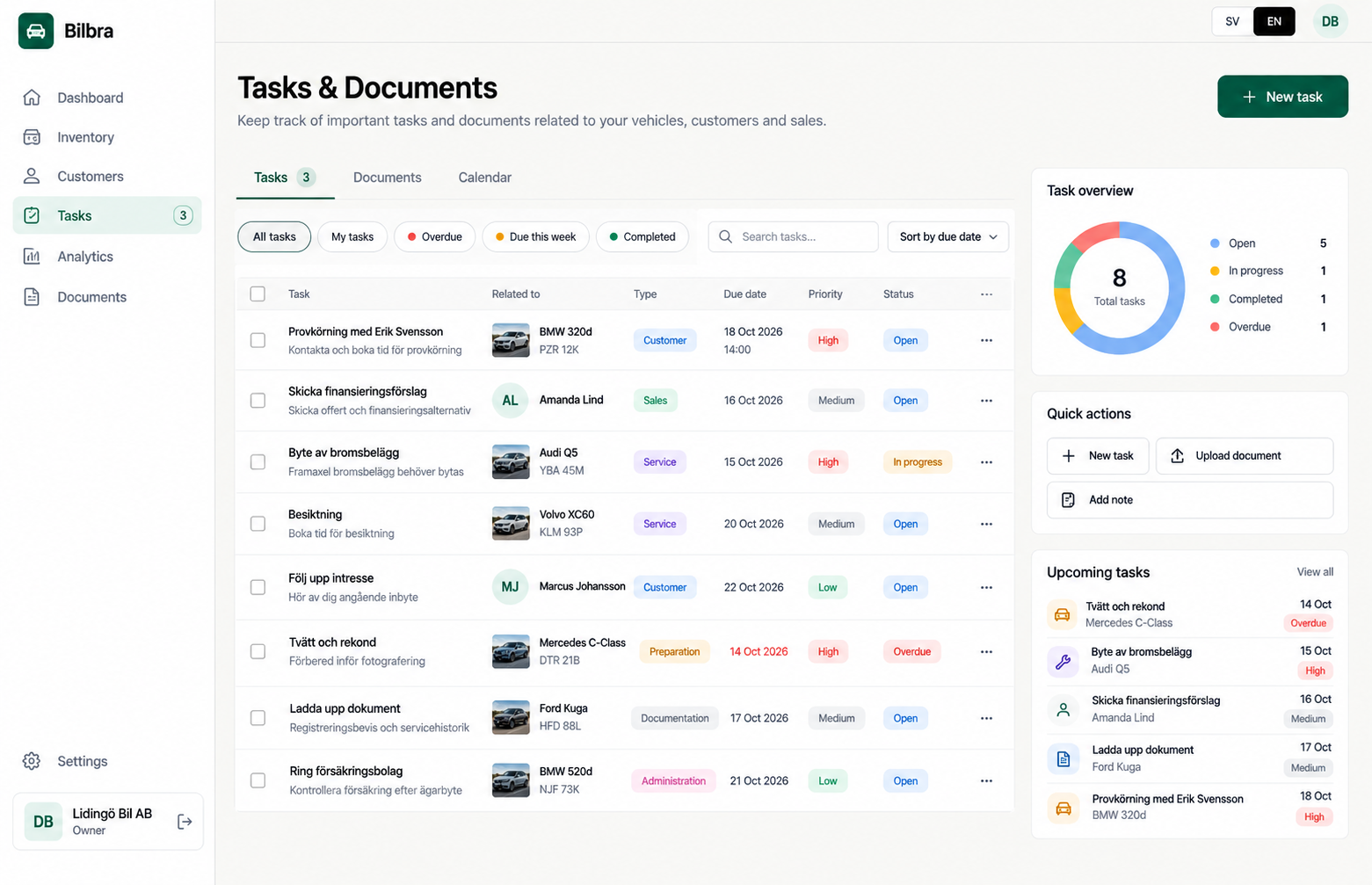
Tasks & Documents
Manage important documents and everyday tasks alongside the vehicles they relate to.
1 / 5
Product interface shown with illustrative demonstration data.
Decisions
Why I Built It This Way
Focus on an Underserved Market
Why
Existing software appeared better suited to larger dealerships, creating an opportunity to serve smaller businesses with a focused, affordable alternative.
Trade-off
A narrower target audience and fewer enterprise-level features.
Make Adoption Easy
Why
Dealerships accustomed to Excel should be able to transfer their inventory without starting from scratch. The interface should also be simple to learn.
Trade-off
Supporting different spreadsheet formats and simplifying complex workflows requires additional development work.
Put Profitability at the Centre
Why
Dealership owners need to understand how much money is invested in each vehicle and what they stand to earn when it sells.
Trade-off
Accurate financial insights depend on users recording their costs consistently.
Prioritise Essential Features
Why
I wanted a practical MVP that smaller dealerships could use without navigating unnecessary features.
Trade-off
More advanced integrations and automation would come later.
Lessons Learned
- Understanding the workflow comes first
- A useful product starts with understanding how people actually work, not simply adding features.
- Simple products still solve complex problems
- The challenge isn't always building more functionality. Sometimes it's deciding what to leave out.
- Profitability is more useful than activity
- Tracking vehicles and sales is valuable, but connecting that information to financial outcomes makes the product more meaningful.
Current Status
- Working MVP
- A functional web application has been developed with inventory, vehicle costs, customer records, follow-ups, tasks, documents and sales tracking.
- Early Validation
- A small dealership expressed interest in testing the concept.
- Next Step
- Conduct real-world testing, gather feedback and refine the product before expanding its functionality.
Roadmap
Future Vision
- 01
Blocket Integration — In Progress
I am currently working on connecting Bilbra to Blocket's API, with two intended capabilities. Neither is available yet.
1. Create and manage vehicle advertisements directly from Bilbra, subject to the available API permissions.
2. Compare vehicles against similar listings on Blocket to help dealers choose competitive asking prices and avoid undervaluing their stock, subject to data access.
- 02
Sales Intelligence
Provide clearer insights into vehicle profitability, stock turnover and overall dealership performance.
- 03
Integrations
Explore connections with existing dealership software, accounting platforms and external services to reduce duplicated work.
Final Reflection
Bilbra began with recognising a gap between expensive, complex dealership systems and smaller dealerships relying on spreadsheets.
The experience has reinforced my belief that successful products don't always need more features. They need to be accessible, intuitive and focused on solving the right problems.
My next priorities are testing Bilbra with real dealerships, refining the onboarding experience and progressing the Blocket integration.
Next story
Stemli